


 Cart
Cart
 sales@molnova.com



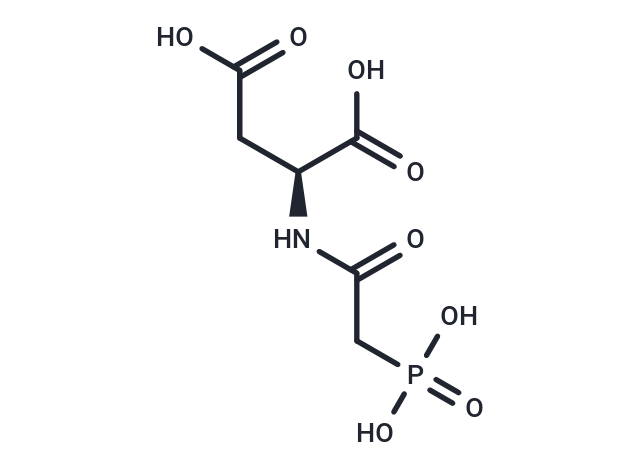
Sparfosic Acid
CAS No. 51321-79-0
Sparfosic Acid( —— )
Catalog No. M34033 CAS No. 51321-79-0
Sparfosic Acid (Acide sparfosique) is an aspartate carbamoyltransferase inhibitor with antitumor activity and can be used to study advanced renal cell carcinoma.
Purity : >98% (HPLC)
 COA
Datasheet
HNMR
HPLC
MSDS
Handing Instructions
COA
Datasheet
HNMR
HPLC
MSDS
Handing Instructions
| Size | Price / USD | Stock | Quantity |
| 2MG | 347 | Get Quote |


|
| 5MG | 546 | Get Quote |
|
| 10MG | 782 | Get Quote |
|
| 25MG | 1159 | Get Quote |
|
| 50MG | 1500 | Get Quote |
|
| 500MG | Get Quote | Get Quote |
|
| 1G | Get Quote | Get Quote |
|
Biological Information
-
Product NameSparfosic Acid
-
NoteResearch use only, not for human use.
-
Brief DescriptionSparfosic Acid (Acide sparfosique) is an aspartate carbamoyltransferase inhibitor with antitumor activity and can be used to study advanced renal cell carcinoma.
-
DescriptionSparfosic acid, a DNA antimetabolite agent, is a potent inhibitor of aspartate transcarbamoyl transferase, the enzyme catalyzing the second step of de novo pyrimidine biosynthesis. Sparfosic acid synergistically enhances the cytotoxicity of a combination of 5-fluorouracil (5-FU) and interferon-alpha (IFN) against human colon cancer cell lines.
-
In VitroSparfosic acid (N-(Phosphonacetyl)-L-aspartate, PALA) causes apoptosis in the resistant Br1 cells.Sparfosic acid (300 μM) shows progressive accumulation of cells in S phase and activation of an apoptotic pathway leading to cell death.:Cell Viability Assay Cell Line:Br-l and L-2 cell lines established from metastasis in nude mouse injected with the human tumor cell line MDA-MB-435 Concentration:300 μM Incubation Time:12, 24 and 48 hours Result:Cells were predominantly in S phase in both the cell lines, although slightly higher proportion of cells in S phase were noted in L-2 than Brl-3prl cells.Western Blot Analysis Cell Line:Br-l and L-2 cell lines Concentration:300 μM Incubation Time:4, 10 and 24 hours Result:There was moderate difference in the level of phosphorylated Rb proteins seen in the two cell types.Marked increase in the amount of cyclin A protein was detected in the L-2 cells undergoing apoptosis with the highest level detected at 10 h post-drug treatment.In contrast, there was no increase in the level of cyclin A seen in the Brl-3prl cells.Cyclin E protein was found elevated in the L-2 cells and Brl-3prl cells compared to their respective controls.
-
In VivoSparfosic acid (490 mg/kg; i.p.; on days 1, 5, and 9; mice bearing B16 melanoma) shows the life-span is increased survives 77 to 86% longer than controls. Lewis lung carcinoma is highly sensitive to Sparfosic acid. Treatment on days 1, 5, and 9 following s.c. implantation of Lewis lung carcinoma is curative to 50% of the mice.
-
Synonyms——
-
PathwayApoptosis
-
TargetApoptosis
-
RecptorApoptosis
-
Research Area——
-
Indication——
Chemical Information
-
CAS Number51321-79-0
-
Formula Weight255.12
-
Molecular FormulaC6H10NO8P
-
Purity>98% (HPLC)
-
SolubilityIn Vitro:?H2O : 125 mg/mL (489.97 mM; Ultrasonic)
-
SMILES[C@H](NC(CP(=O)(O)O)=O)(CC(O)=O)C(O)=O
-
Chemical Name——
Shipping & Storage Information
-
Storage(-20℃)
-
ShippingWith Ice Pack
-
Stability≥ 2 years
Reference
1. Wang J, et al. Elevated cyclin A associated kinase activity promotes sensitivity of metastatic human cancer cells to DNA antimetabolite drug. Int J Oncol. 2015 Aug;47(2):782-90.?
molnova catalog



related products
-
Ecdysone
Ecdysone is a major steroid hormone in insects and herbs. Ecdysone triggers mineralocorticoid receptor activation and induces cellular apoptosis. Ecdysone signaling through Ecdysone receptor isoform B1 is required cell autonomously for the muscle death.
-
UCF 101
UCF 101 is a specific inhibitor of HtrA2 and reduces apoptosis in PC12 cells.
-
Daporinad hydrochlor...
Daporinad hydrochloride (FK 866 hydrochloride) is a potent nicotinamide-phosphate ribosyltransferase (NAMPT) inhibitor with potential anti-tumor and anti-angiogenic activity that induces apoptosis in tumor cells.
